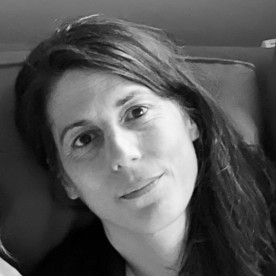
Véréna Paravel (born 1971 in Neuchâtel, Switzerland) is a French anthropologist, visual artist, and filmmaker. Based in the United States since 2004, she teaches at Harvard University and has worked closely with the Sensory Ethnography Laboratory. Her award-winning works have been screened internationally and are held in the permanent collections of MoMA and the British Museum.
De Humani Corporis Fabrica
De Humani Corporis Fabrica


De Humani Corporis Fabrica
Synopsis
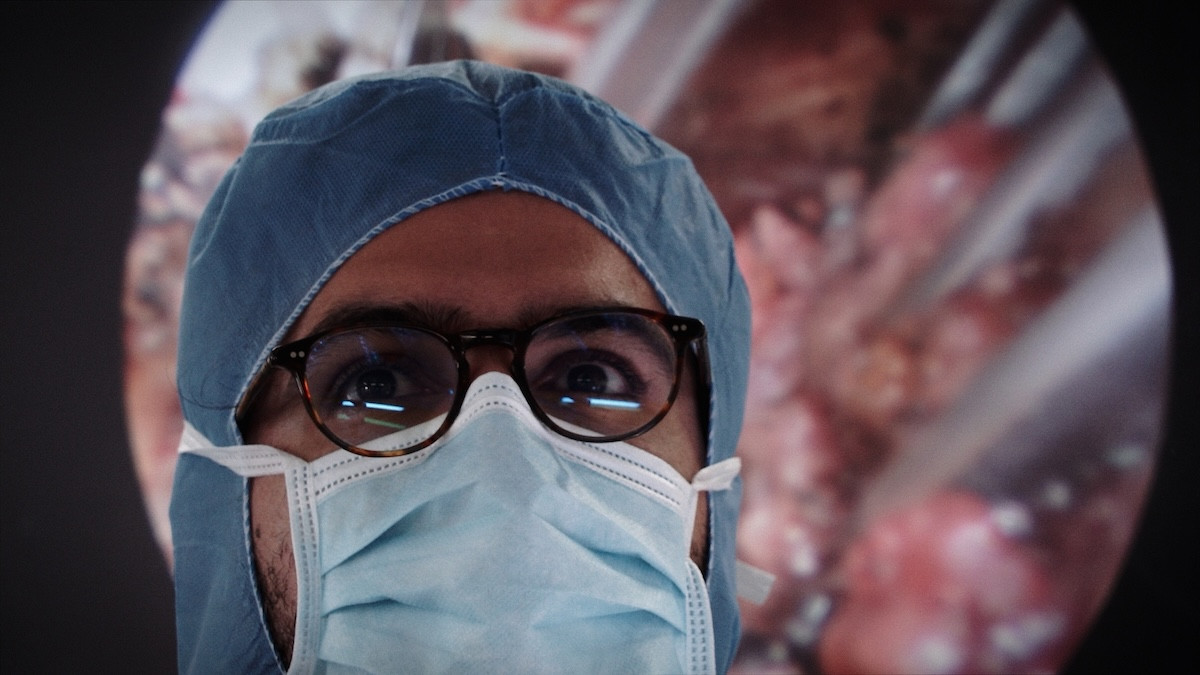
Five centuries after anatomist Andreas Vesalius opened the human body to science, De Humani Corporis Fabrica opens it to cinema. Revealing flesh as an extraordinary landscape shaped by care, suffering and hope, the film presents hospitals as laboratories that connect every body in the world.
Véréna Paravel: "The film doesn't claim to play a role comparable to that of Vesalius in the history of medicine. But we do try to open up our bodies and look at them with new eyes, [...] one that adds movement, time, texture, and sound to still anatomical imagery. This has physical, technical, political, spiritual, and existential implications, which are all being reconfigured in the present moment [...] The film's ambition is to help us reinterpret our body and its relationship to the world.’
Lucien Castaing-Taylor: "We started filming with a regular camera, but were unhappy with our footage: it seemed too déjà vu and distanced us from both patients and surgeons. So then we asked our friend Patrick Lindenmaier to build a very small camera with an aesthetic very close to that of medical lenses, with a miniature lens that would give us as much freedom to move around as possible. Practically everything we filmed was with this camera, and it provided us with images whose texture links us to the tools used by doctors and surgeons, material that makes up maybe half of the film. The hope was that the similarities (in terms of depth of field and angle of view) between the footage inside and outside the body would encourage viewers to rethink the relationship between interiority and exteriority, the self and other, and generally evoke the infinite interdependencies between different bodies — human and non-human, animate and inanimate.’
— Excerpted from an interview with Jean-Michel Frodon
Festivals & Awards
2022 Cannes
2022 IDFA
Director's Profile
Véréna PARAVEL
Filmography
2009 Foreign Parts
2012 Leviathan
2013 Still Life
2015 Ah Humanity!
2016 Somniloquies
2017 Commensal
2017 Caniba
2022 De Humani Corporis Fabrica
Director's Profile
Lucien CASTAING-TAYLOR
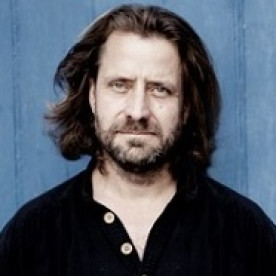
Lucien Castaing-Taylor, born in 1966 in Liverpool, is a British anthropologist and filmmaker. He teaches at Harvard University and is the director of the Sensory Ethnography Laboratory. Seeking to conjugate art's negative capability with an ethnographic attachment to the flux of life, his work has been widely exhibited at major film festivals and institutions, and is held in the permanent collections of MoMA and the British Museum.
Filmography
1992 In and Out of Africa
2009 Sweetgrass
2012 Leviathan
2013 Still Life
2015 Ah Humanity!
2016 Somniloquies
2017 Commensal
2017 Caniba
2022 De Humani Corporis Fabrica
Credit
Producer|Valentina NOVATI, Charles GILLIBERT, Pauline GYGAX, Max KARLI, Lucien CASTAING-TAYLOR, Véréna PARAVEL
Cinematographer/Editor|Lucien CASTAING-TAYLOR, Véréna PARAVEL
Sound Design|Nicolas BECKER
Sound Editor|Matthieu FICHET, Raphaël SOHIER
Sound Mix|Bruno EHLINGER
Print Source
Les Films du Losange|sales@filmsdulosange.fr, h.akbaraly@filmsdulosange.fr