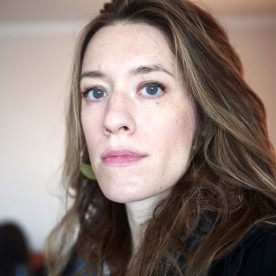
Stephanie Spray is a filmmaker, anthropologist and educator whose work explores the confluence of social aesthetics and art of everyday life. She is Associate Professor of Anthropology and Cinematic Arts at the University of Southern California, where she also directs the Center for Ethnographic Media Arts. Her work lies at the intersection of ethnography and art, with research interests in visual, sonic and media anthropology, and everyday religious practices.
Manakamana
Manakamana


Manakamana
Synopsis
High above Nepal's mountainous landscape, a cable car carries pilgrims, villagers and tourists to the ancient Hindu temple of the goddess Manakamana. Once a multi-day pilgrimage, the journey now takes minutes. Filmed entirely inside the cars, Manakamana captures intimate conversations, revealing a society suspended between ritual tradition and technological change.
Pacho Velez: 'When I was a student at CalArts, I directed quite a bit of theatre, and I was intrigued by the "doubleness" of acting — actors' studied non-attention to their audience. This interest carries over for me into Manakamana — I'm watching the subjects' awareness of their world, and how it shifts to acknowledge the passing landscape, other passengers, and private thoughts, before occasionally, obliquely returning to the camera, which is so clearly staring at them, yet is never explicitly addressed. These switches between different sorts of focus are crucial because they create the pace of the individual shots, which in turn creates the rhythm of the entire film. To make edits in the shots would have imposed another sort of rhythm on top of the material, obscuring these internal cadences. Our pace of editing was glacial. The final film has only eleven shots, but it took us eighteen months of editing to arrive at it, which works out to our deciding on one shot every forty days or so.’
Stephanie Spray: 'Contrary to what many assume, Pacho and I were both inside the 5'×5' cable car along with our riders; we didn't simply send them off alone; this would have been technically almost impossible and wouldn't have created the same tensions — between avowal or disavowal of the camera, and the different degrees of complicity, indifference, and discomfiture it engenders. […] The distinction between fiction and non-fiction is frequently murky, and the documentary engagement with the real is found across genres, but extremely hard to get on film, since most film subjects slip into becoming someone other than themselves, self-conscious representations, even if they are not purportedly acting. In Manakamana, the trip itself is surreal; passengers are propelled above a jungle in Nepal, en route to a temple inhabited by a goddess who demands blood sacrifice. Most passengers have never been in aeroplanes, and the time aloft can be frightening and exhilarating. This detachment it bestows upon the journey for the passengers heightens the sense that this world is fictional, for it is indeed a manufactured and unnatural experience for most of them.’
Festivals & Awards
2013 Locarno FF
2013 Toronto IFF
Director's Profile
Stephanie SPRAY
Filmography
2007 Kāle and Kāle
2008 Monsoon-Reflections
2009 Untitled
2010 As Long as There’s Breath
2013 Manakamana
Director's Profile
Pacho VELEZ
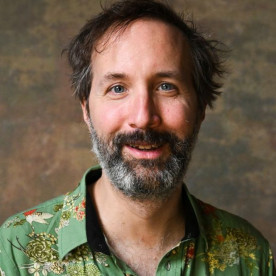
Pacho Velez is a filmmaker whose work sits at the intersection of ethnography, structuralism and political documentary. His films explore local responses to the broad changes wrought by globalisation. He received his MFA from CalArts in 2010 and is currently Assistant Professor of Screen Studies at The New School.
Filmography
2002 Occupation
2004 Orphans of Mathare
2010 Bastards of Utopia
2013 Manakamana
2017 The Reagan Show
2017 Mr. Yellow Sweatshirt
2020 The American Sector
2021 Searchers
2024 They’re Here
Credit
Producer|Lucien CASTAING-TAYLOR, Véréna PARAVEL
Camera Operator|Pacho VELEZ
Sound Recordist|Stephanie SPRAY
Editor|Stephanie SPRAY, Pacho VELEZ
Sound|Ernst KAREL
Print Source
Pacho VELEZ|Velezp@newschool.edu