
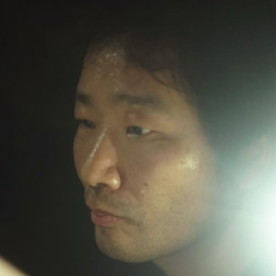
Lee Jangwook works with film-based practice and expanded cinema, including live film performance. In 2004 he founded Space Cell, an ongoing platform supporting experimental film and handmade analogue processes. His works are held in the collections of the Korean Film Archive and the Asia Culture Centre, and have screened internationally at festivals and art institutions.
Chang Gyeong
Chang Gyeong


Chang Gyeong
Synopsis
Changgyeonggung Palace is a space where the zoo, amusement park, and ancient palace overlap. Remembered as a childhood fantasy with a sense of unease, it becomes a layered image of animal suffering and everyday landscapes shaped by war and liberation. Rhythmic sound over superimposed images reveals fractures between past and present, fantasy and trauma.
Lee Jangwook: 'As a child, the zoo was a space that gave me a sense of fantasy. In particular, Changgyeonggung (then called Changgyeongwon) was a strange place where a zoo, an amusement park, and an old palace coexisted. Childhood memories perhaps remain as emotional vestiges — of events there, of people, of food, of weather, and so on. It was not a specific event, but a personal emotion lying somewhere at the boundary between reality and the virtual. Through education, I learned that the coexistence of these elements stemmed from the tragic modern history of Changgyeonggung (during the Japanese occupation, a zoo was created to mock and degrade Changgyeonggung Palace).
Even then, Changgyeonggung has a history of animals being victimised during liberation and the Korean War. After learning this history, the space of Changgyeonggung Palace no longer aroused any of my earlier emotional responses. Emotional memories that had formed ambiguous boundaries between reality and fantasy began to split in two, and at the same time no emotion remained on either side.’
Festivals & Awards
2025 Berlinale
2025 Jeonju IFF
Director's Profile
LEE Jangwook
Filmography
1998 Echoed Silence
1999 Surface of Memory, Memory on Surface
2007 Hibernation
2012 Stillness of the Garden
2012 Thin Traces
2013 Landscape in the Afternoon
2013 Autumn Film
2013 Conversation Print 1
2015 Lazimpat
2015 Sunday Seoul
2019 Surface Memory Oblivion
2024 Chang Gyeong
2025 Photosynthesis Part 1
2025 Station
Credit
Scriptwriter/Cinematographer/Editor/Sound Design|LEE Jangwook
Print Source
LEE Jangwook|spacecell2004@gmail.com
Shown in...
Stranger than Documentary #2